The Difference Between Failing and Successful Traders|Habits and Mindsets to Get Results with EdgeGraph FX
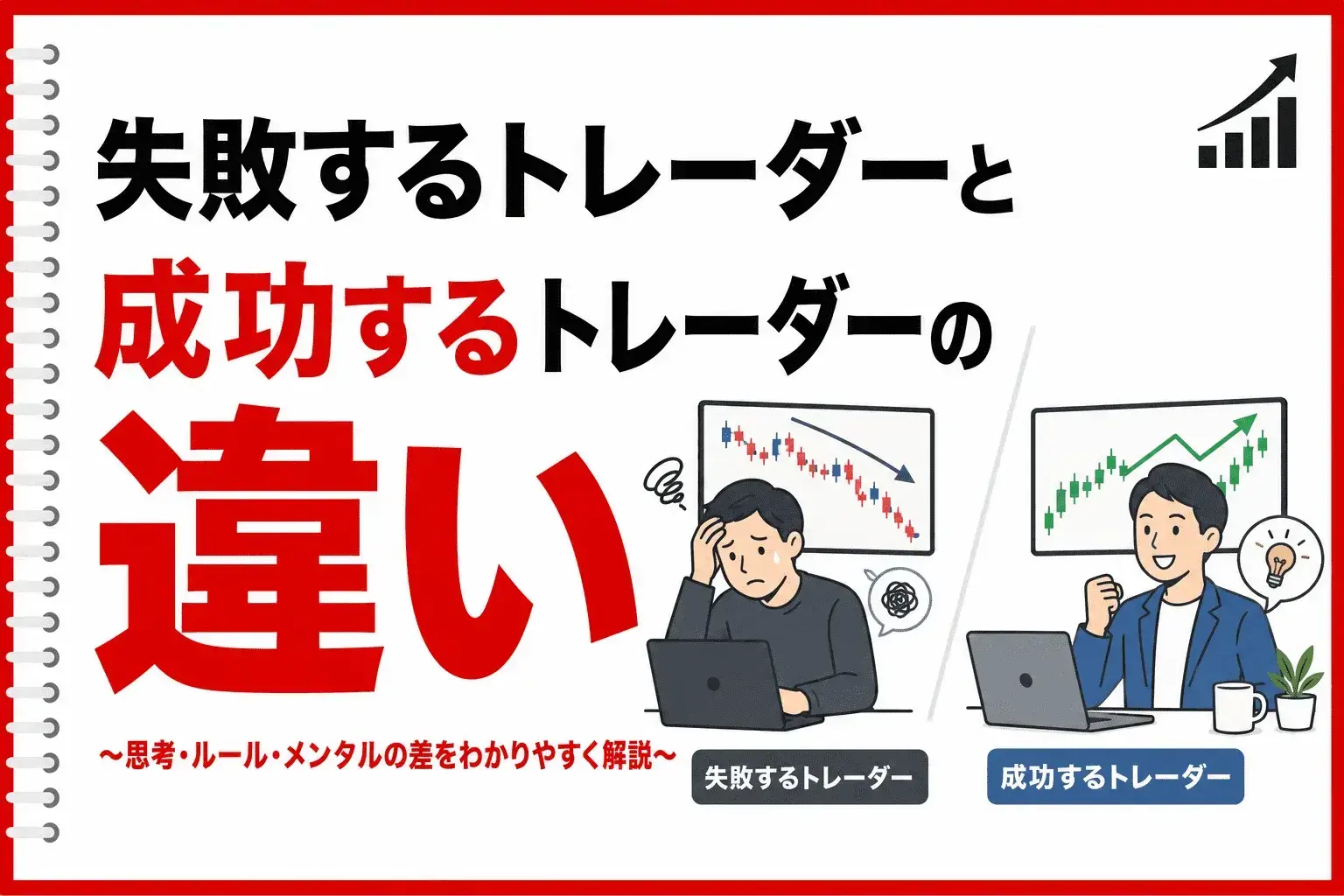
"We're looking at the same chart — so why is that person the only one making a profit?" If you've been trading for any length of time, you've probably asked yourself this at least once.
To get straight to the point: what separates successful traders from failing ones isn't talent or intuition — it's "habits" and "patterns of thinking." Even using the same strategy, results can be completely different between someone who can follow the rules and someone who can't.
In this article, we'll break down **the differences between the two across three layers: "characteristics," "the fundamental gap," and "steps to break out of failing patterns."** We've also prepared a self-assessment checklist, so use it as an opportunity to reflect on your own trading.
Table of Contents
The Bottom Line: The Difference Lies in "Habits and Mindset," Not "Talent"
First and foremost, various data consistently show that the trading market is "not a place where you can easily keep winning."
- According to CFD/FX broker disclosure data published by overseas regulatory authorities (such as ESMA and CFTC),roughly 70–85% of retail investors incur losses.
In other words, it's an oversimplification to say "only 10% can win" or "more than half can win" — but the consistent takeaway from various data sources is that "this is not a market where you can win consistently without preparation."
What creates this gap is whether you can:
- Execute stop-loss rules
- Maintain strict money management
- Record and review your trades
- Make decisions based on probability rather than emotion
— in other words, "the accumulation of reproducible actions." Conversely, this also means there is significant room for improvement by restructuring your habits.
7 Characteristics of Failing Traders
Failing traders share common behavioral patterns.
1. Unable to Cut Losses
When sitting on an unrealized loss, they think "maybe it'll recover if I wait a little longer" and keep putting off the stop-loss. This isthe number one typical losing pattern, and as a result, a small loss can suddenly become fatal. This is a classic example of "loss aversion bias" as explained by Prospect Theory — a psychological trap that can happen to anyone.
2. No Money Management Rules
They haven't decided how much they're allowed to lose per trade or what percentage of loss they can tolerate. They change their lot size based on how they feel, bet big when winning, and increase even further when losing in an attempt to win it back.
3. Entering Based on Emotion
They enter trades driven by FOMO (Fear of Missing Out) — thinking "it feels like it's going up" or "I don't want to miss out." They act on the emotion of the moment rather than pre-defined rules.
4. Overtrading (Compulsive Trading)
They feel restless without an open position and end up entering trades even with weak justification. High-frequency traders are said to significantly underperform passive investment strategies on an annualized basis.
5. No Verification or Record-Keeping
They trade without any follow-up review. Because they never put into words why they won or why they lost, they repeat the same mistakes.
6. Frequently Changing Strategies
When things aren't working, they immediately go looking for a different strategy — a "holy grail" mentality.Every strategy has its own win rate and appropriate use cases, yet they abandon them without taking sufficient time to test them.
7. Using Too Much Leverage
Driven by a desire to "make big profits quickly," they trade with high leverage that doesn't match their capital size. One mistake can wipe out the entire account balance.
7 Characteristics of Successful Traders
Traders who consistently generate long-term profits have behavioral patterns that may seem unglamorous but are remarkably consistent.
1. Execute Stop-Losses Mechanically
They decide on their stop-loss level before entering, and when it's hit, they cut without hesitation. They accept that "stop-losses are part of trading" and have no resistance to locking in a loss.
2. Limit Risk per Trade to 1–2% of Capital
They fix the amount they're allowed to lose per trade at around 1–2% of their account balance. The system is designed so that even a losing streak won't be fatal, and they prioritize staying in the market over the long term.
3. Make Rule-Based Decisions
They operate according to pre-defined rules: "If this pattern appears, enter; if it doesn't, pass." By minimizing the room for emotion to creep in, they reduce inconsistency in their decision-making.
4. They Can Wait
They can wait hours or even days for the right entry opportunity. They truly live by the principle that "waiting is part of the job," and they don't feel uncomfortable not having an open position.
5. Keep Trade Records and Review Them Regularly
They record their entry rationale, reasons for taking profit or cutting loss, and reflections in a notebook or spreadsheet. They review on a weekly and monthly basis and apply improvements to their next trades.
6. Refine a Single Strategy Thoroughly
They test and trade the strategy they've committed to for at least several months, verifying its tendencies and the market conditions it performs best in.Not constantly switching strategiesis their common trait.
7. Keep Leverage Conservatively Controlled
They work backward from their account's acceptable risk to select the appropriate leverage and lot size. They manage their capital with "survival" as the top priority.
The 4 Fundamental Differences That Separate the Two
From the 7 characteristics, here are the 4 more fundamental differences.
① Difference in Goal-Setting
Failing traders
・Want to make big profits in the short term
・Prioritize staying in the market for the long term
Successful traders
・Aim for a single big reversal win
・Accumulate trades with a positive expected value
② Difference in How Losses Are Perceived
Failing traders
・Loss = failure / shame
・Loss = cost / part of trading
Successful traders
・Feel that a stop-loss is a "defeat"
・Recognize a stop-loss as "the correct action per the rules"
③ Difference in Relationship with Information
Failing traders
・Take social media posts and streams at face value
・Verify independently before adopting
Successful traders
・Immediately copy the strategy of someone "who is winning"
・Understand the premise and market conditions of a strategy before using it
④ Difference in Time Horizon
Failing traders
・Seek results today or this week
・Evaluate over months to years
Successful traders
・Withdraw or change strategies after just a few losses
・Withhold judgment until a statistically sufficient number of trades have been made
4 Steps to Break Out of Failing Patterns
Even if you feel you identify with the failing side, it's possible to course-correct by restructuring your habits. Follow these steps in order to break out of failing patterns.
Step 1: Write Down Your Money Management Rules
First, whether on paper or in an app, write down the following somewhere you can always refer to.
- The maximum amount you're allowed to lose per trade (guideline: 1–2% of capital)
- Maximum daily loss (once reached, stop trading for the day)
- Maximum monthly drawdown tolerance
Simply "writing down" the rules can significantly curb emotionally driven lot increases.
Step 2: Always Set Your Stop-Loss First
Get into the habit of always placing a stop-loss order at the same time as your entry. Simply committing to "never trade without a stop-loss in place" will dramatically reduce the chance of taking a fatal hit.
Step 3: Keep a Trade Journal
A spreadsheet is fine. At a minimum, record the following.
- Entry date/time, currency pair, direction
- Entry rationale (rule name or conditions)
- Outcome and reason for take-profit/stop-loss
- Reflections and insights
Simply reviewing it at the end of each week will make your own losing patterns visible.
Step 4: Set a Defined Testing Period
When trying a new strategy, run it under the same rules forat least 30–50 tradesbefore evaluating it. If you change the rules partway through on a whim, you won't be able to tell what worked and what didn't.
Summary
What separates successful traders from failing ones is not special talent or information — it's whether you can:
- Execute stop-losses mechanically
- Maintain money management rules consistently
- Keep up with recording and reviewing trades
- Stay in the market with a long-term perspective
— the difference lies in these unglamorous but reproducible habits.
Even when making use of a trading environment like EdgeGraph FX, the fastest path forward starts with "systematizing your rules" and "keeping records" of your own trading. It's not the superiority of your strategy, but the superiority of your habits, that has the greatest impact on long-term performance.
Things you can start doing tomorrow:
- Decide your stop-loss range before entering
- Fix your risk per trade at 2% or less of your capital
- Leave at least one line of trade notes
These are the 3 things. They may seem unglamorous, but starting small and staying consistent is what matters most for surviving in the market.