What Is High Leverage in FX? How Many Times vs Japan's 25x
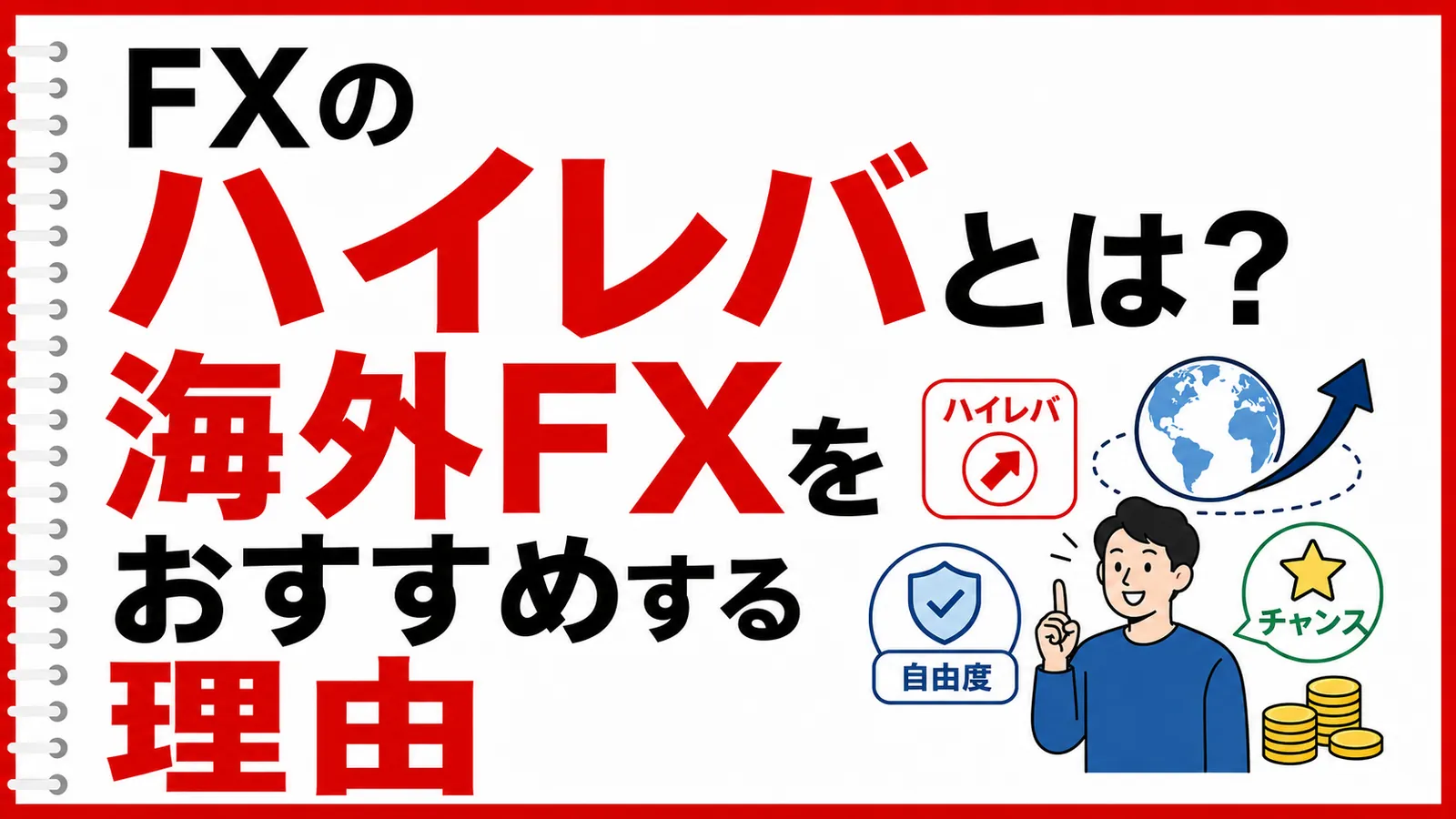
High leverage means trading with a high multiple of your own capital. There is no fixed definition of how many times counts as high, but because domestic FX in Japan is capped at 25x, the term is used for anything above that, in practice overseas FX offering hundreds to thousands of times.
Many people assume that raising leverage makes losses grow by the same amount. In fact, as long as you hold the same trading volume, the profit or loss from price movement is the same at 25x or at 1,000x. What leverage changes is the margin required to hold that volume.
This article covers a quick-reference table of the amount you can trade by capital, concrete required margin calculations, the relationship between stop out and zero cut, and how to decide the leverage that suits you.
Experience flexible trading with up to 1,000x leverage and industry-low spreads!
Open an EdgeGraph FX Account HereTable of Contents
What Is Leverage in FX?
Leverage is a mechanism that uses your own funds as collateral to trade amounts many times larger. It is called leverage because, like the principle of a lever, it evokes the image of moving something large with a small force.
The amount you can trade is determined by "margin × leverage multiple." For example, with ¥100,000 of margin and 25x leverage, you can trade ¥2.5 million. At 100x, that becomes ¥10 million. Because you can make large trades even with a small amount of funds, it becomes easier to grow profits, which is the biggest advantage of leverage.

"Hairebu" is Japanese shorthand for "high leverage" and refers to a state where this multiple is high. In domestic FX, the required margin ratio for retail over-the-counter FX for individuals is uniformly set at 4% or more, and leverage is limited to a maximum of 25x. This is a regulation introduced after the Lehman Shock to curb excessive speculation. Overseas FX brokers, on the other hand, are outside the scope of Japan's Financial Instruments and Exchange Act and offer high leverage of hundreds to thousands of times.
This Is How Much the Tradable Amount Differs Between Domestic FX and Overseas FX
Looking only at the multiple numbers, it is hard to picture how big the actual difference is. So we prepared a quick-reference table that lines up "how much you can trade" for each amount of capital in domestic FX and overseas FX.
Quick-reference table of tradable amounts by capital
| Your capital | Domestic FX (25x) | Overseas FX 100x | Overseas FX 500x | Overseas FX 1,000x |
|---|---|---|---|---|
| ¥50,000 | ¥1.25 million | ¥5 million | ¥25 million | ¥50 million |
| ¥100,000 | ¥2.5 million | ¥10 million | ¥50 million | ¥100 million |
| ¥300,000 | ¥7.5 million | ¥30 million | ¥150 million | ¥300 million |
For example, with ¥100,000 of capital, domestic FX lets you trade up to ¥2.5 million, but with overseas FX at 1,000x leverage you can theoretically trade ¥100 million. Because the trading volume you can hold differs so much even from the same starting capital, there is a big advantage in capital efficiency for those who want to start with a small amount.
However, just because you can trade ¥50 million with ¥50,000 does not mean your loss will also be ¥50 million. Leverage of 1,000x is a mechanism that lets you hold a position with margin equal to 1/1,000 of the trade amount. Profit and loss in FX is determined by "the width of the exchange rate move × trading volume," and for the same trading volume, the profit or loss from a price move is the same whether leverage is 25x or 1,000x.
For example, when $1 = ¥150, the margin required for a trade of 10,000 units of currency (¥1.5 million worth) is ¥60,000 at 25x in domestic FX, and in theory ¥1,500 at 1,000x. In this way, the advantage of high leverage is that you can hold the same trading volume with less margin. However, if you hold a trading volume that is too large relative to your funds, even a small price move makes a stop out more likely, so keeping a margin of safety in your fund management is essential.

However, this is a theoretical upper limit mechanically calculated as "margin × multiple." The amount you can actually order varies with the required margin of each currency pair and each broker's maximum lot limit. And above all, you do not need to use the limit to the fullest. You can decide for yourself what leverage you actually trade at.
Why High-Leverage Trading Is Realistic with Overseas FX
The higher the leverage, the larger the proportion of loss relative to margin. When unrealized loss exceeds a certain level of your margin, a "stop out" is triggered that closes your positions by force, and losses stop growing beyond that. With high leverage, it is worth knowing in advance that the price move needed to reach this stop out becomes smaller.

That said, there are two reasons why high-leverage trading with overseas FX is so widely chosen: a mechanism called negative balance protection, and the ability to adjust the multiple yourself.
How Negative Balance Protection Works
Negative balance protection is a mechanism under which, even if a sudden market move causes a loss exceeding your account balance, the broker bears the negative amount. Many overseas FX brokers use it.
Domestic FX cannot adopt this mechanism because of the loss compensation prohibition under the Financial Instruments and Exchange Act, and when a loss exceeds the account balance, an obligation arises to deposit the shortfall, known as a "margin call." In other words, in a sudden market move there is a risk of carrying a loss larger than the amount you deposited. With negative balance protection in overseas FX, your account balance never goes negative, so you do not have to worry about losing more than the funds you put in. It is this peace of mind that makes it easy to operate even at high leverage.
If you want to know more about how negative balance protection works in overseas FX, check out this article!
How to Choose a Reasonable Leverage
What matters with high leverage is that "the maximum multiple is not the multiple you use all the time." Even with a 1,000x account, you can actually trade at 1x or 10x. The multiple at which you are actually trading is called effective leverage, and it is a separate metric from the maximum leverage that is the account's upper limit. The higher the upper limit, the more flexibility you gain, such as being able to start from a smaller lot and keep room to spare even with the same funds.
You can check the multiple that suits you in the following 3 steps.
- Check the amount of your own capital
- Decide how wide a price move you can tolerate with those funds
- Work backwards from what you can tolerate to the multiple and number of lots you will actually use
If you think in this order, you can use high leverage while still trading in a way that is manageable for you. Overseas FX, which lets you choose a high multiple, is not "a place that forces you into a dangerous multiple"; if you set your own risk tolerance, there is a chance to aim for big profits.
To check the relationship between the multiple and the required margin with concrete numbers, the article that does the calculation with gold is a useful reference.
Disadvantages of High Leverage and Common Mistakes
The multiple itself does not change your profit or loss, but because it lets you hold a larger trading volume, the price range before a stop out becomes narrower. Let's look at concrete numbers.
Calculating Effective Leverage
Effective leverage is calculated as "trade amount ÷ account balance." With an account balance of ¥100,000 and USD/JPY at ¥150, holding 10,000 units of currency (worth ¥1,500,000) gives an effective leverage of 15x, 50,000 units (worth ¥7,500,000) gives 75x, and 100,000 units (worth ¥15,000,000) gives 150x.
When an unrealized loss appears, equity decreases, so effective leverage rises even with the same lot size. For example, if you keep holding 10,000 units of currency and the unrealized loss reaches ¥50,000, equity becomes ¥50,000, and ¥1,500,000 ÷ ¥50,000 gives 30x.
How the Price Range Before a Stop Out Differs
Consider buying USD/JPY with an account balance of ¥100,000 on an account with a maximum of 1,000x. The stop out level is a margin level of 20%. The price range before a stop out changes with the amount you hold, as follows.
- 10,000 units of currency (effective leverage 15x): about ¥9.97
- 50,000 units of currency (effective leverage 75x): about ¥1.97
- 100,000 units of currency (effective leverage 150x): about ¥0.97
Margin level is calculated as "equity ÷ required margin × 100." At EdgeGraph FX, a stop out occurs when the margin level falls below 20%. Stop out levels differ by broker.
Common Mistakes with High Leverage
The first is putting in lots up to the account's full limit. If you hold an amount that would be stopped out by an adverse move of less than ¥1, like the 100,000 units above, you cannot withstand sudden price moves such as those right after an economic data release.
Another mistake is increasing your lot size to win back losses. As the account balance shrinks, effective leverage rises, so the price range before a stop out becomes even narrower.
You also need to be careful if you leave everything to the stop out without setting a stop loss. By the time a stop out occurs at a margin level of 20%, most of your margin has already been lost. In the 100,000-unit example above, only about ¥3,000 remains. Negative balance protection applies only to the amount by which your account balance goes negative, and the margin you deposited does not come back.
Leverage Comparison of Major Overseas FX Brokers
When considering a switch to overseas FX, what many people care about are "the leverage number" and "whether negative balance protection is offered." Using these two points as the axes, we compared domestic FX and major brokers.
Leverage comparison of domestic FX and major overseas FX brokers
| Item | Domestic FX | XM Trading | Exness | FXGT | EdgeGraph FX |
|---|---|---|---|---|---|
| Maximum leverage | 25x | 1,000x (varies by account type; Zero account up to 500x) | Unlimited (after meeting conditions; up to 2,000x before) | 500 to 2,000x depending on account type (Optimus account up to 5,000x after meeting conditions) | Up to 1,000x (Micro/Standard account; Pro account 500x) |
| Negative balance protection | No (margin call applies) | Yes | Yes | Yes | Yes |
Compared with domestic FX's 25x, the major overseas brokers all offer leverage that is orders of magnitude higher. XM Trading offers up to 1,000x, Exness offers unlimited leverage after meeting conditions, and FXGT offers up to 2,000x depending on account type, so the height of the upper limit and the way account types are divided differ for each. What they have in common is that all of them use negative balance protection, a design that works well with an approach of aiming big from a small amount. Note that the conditions under which negative balance protection applies and the upper limits differ in the details by broker and account type, so when opening an account it is recommended to check each company's latest terms.
That said, EdgeGraph FX is the easiest place to start for those who want to try small-amount high leverage from now on. The Micro/Standard account comes with leverage of up to 1,000x (500x for the Pro account) plus negative balance protection, and you can choose from 3 account types to suit your purpose. The minimum deposit is as low as ¥1,000, making it easy to start small, trading is on MT5, and when in doubt you can consult the 24-hour Japanese-language support. If you choose not only for the height of the multiple but also for overall ease of use, being able to start comfortably from a small amount and receive support in Japanese, we recommend EdgeGraph FX.
FAQ
Summary
High leverage in FX is a mechanism that lets you make large trades even with a small amount of funds. Domestic FX is limited to a maximum of 25x, but overseas FX lets you use high leverage of hundreds to thousands of times. Because the amount you can aim for changes greatly even with the same capital, overseas FX high leverage is a strong option for those who want to aim big from a small amount.
If you keep in mind that negative balance protection is designed so you do not lose more than you deposited, that the stop out halts the growth of losses at a certain level, and that you can adjust the multiple yourself, there is no need to fear high leverage excessively. First, try how small-amount high leverage behaves on an EdgeGraph FX demo account. You can get a feel for it with no risk. The smaller the amount, the more a slip in entry timing affects your margin under high leverage. Using a free signal tool available on MT5 alongside it makes entry decisions easier in such situations.
If you want to know how to use the free signal tool, check out this article!
Experience flexible trading with up to 1,000x leverage and industry-low spreads!
Open an EdgeGraph FX Account Here