What Is Negative Balance Protection in Overseas FX? How It Works Without Margin Calls and How It Differs from Domestic FX
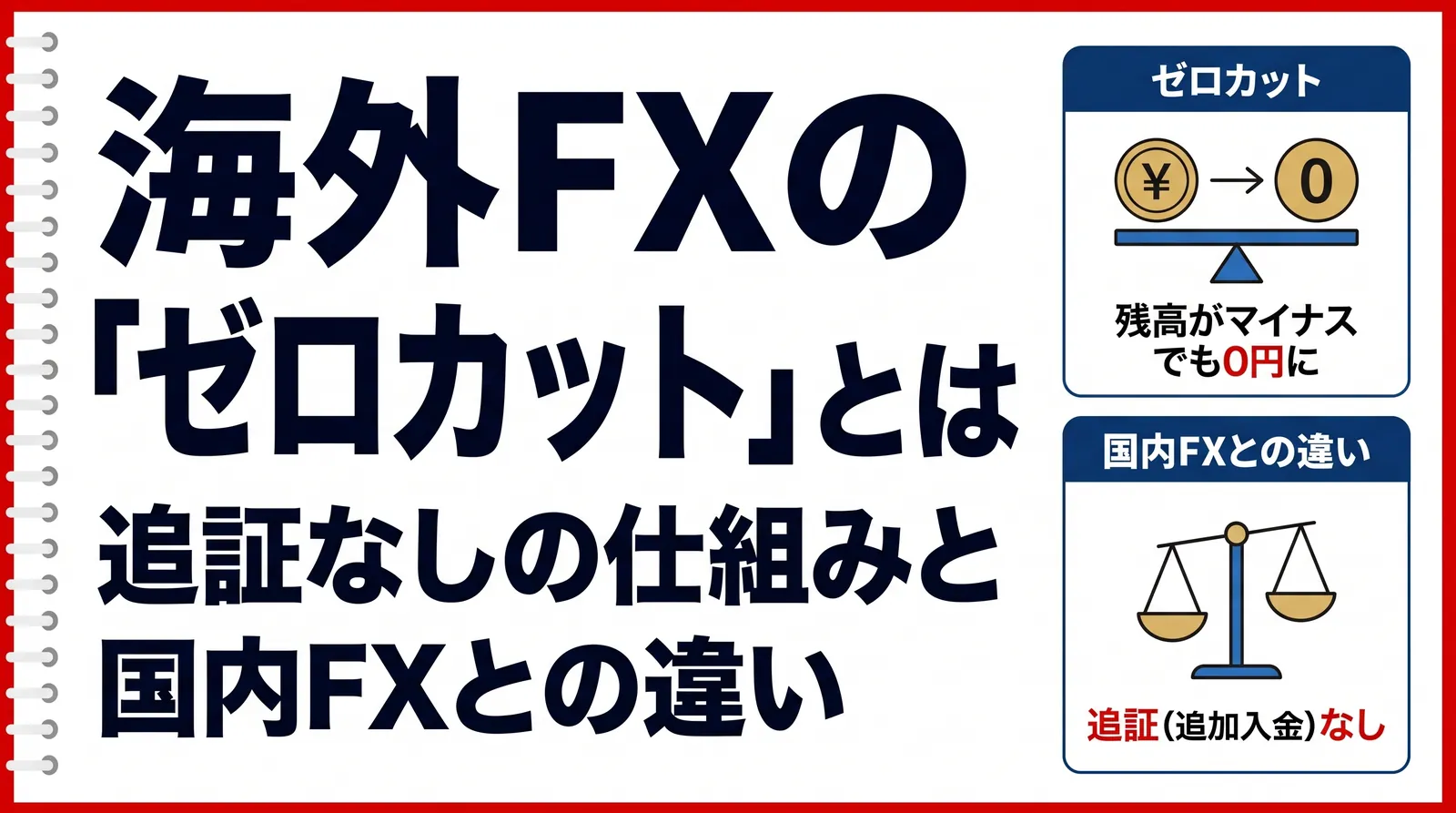
"I've heard that with overseas FX you don't end up in debt even when the market moves suddenly, but is that really true?" This is the first question that trips up people who are interested in overseas FX or thinking of switching from domestic FX. The key to the answer is a mechanism called "negative balance protection" (also known as "zero-cut").
In short, with an overseas FX broker that offers negative balance protection, as long as you trade within the broker's terms, even if your account balance goes negative you will not be asked to deposit extra funds to cover the negative amount, which is known as a margin call. It also prevents the situation where you lose more than you deposited and end up in debt. However, the money you deposited will still shrink as a result of trading, and it can even be lost entirely. You will not be in debt, but you can lose the money you put in. This dividing line is the starting point for understanding negative balance protection.
Experience flexible trading with up to 1,000x leverage and industry-low spreads!
Open an EdgeGraph FX Account HereTable of Contents
- What Is Negative Balance Protection? The Broker Resets a Negative Balance to Zero
- How It Differs from a Margin Call, and the Debt Risk in Domestic FX
- Why Domestic FX Has No Negative Balance Protection: The Loss Compensation Ban in Japan's Financial Instruments and Exchange Act
- The Flow Until Negative Balance Protection Takes Effect: How It Shares Roles with the Stop Out
- Cautions and Easily Misunderstood Points About Negative Balance Protection
- Negative Balance Protection at EdgeGraph FX
- Summary
- FAQ
What Is Negative Balance Protection? The Broker Resets a Negative Balance to Zero
Negative balance protection is a mechanism under which, when a sudden market move pushes your account balance below zero, the broker absorbs the negative amount and returns your balance to zero. Normally the account holder would have to pay the amount that went negative, but with a broker that uses negative balance protection, you are not asked to pay that shortfall.
For example, suppose you deposited ¥100,000 and are trading, and a sudden market move pushes your balance to negative ¥30,000. When negative balance protection takes effect, this ¥30,000 negative amount is handled by the broker and your account balance returns to zero. You will not receive a request to deposit an additional ¥30,000.

Why You Are Not Billed a Margin Call
In domestic FX, when your margin level falls below a certain level, you are asked to deposit more funds. This is the "margin call." If the margin level still does not improve and the market then moves suddenly, the stop out may not execute in time and your account balance can go negative, and you may be asked to pay that shortfall. With overseas FX brokers that use negative balance protection, such margin calls do not occur.Your loss stays within the money you deposited. The fact that you cannot lose more than you deposited is one of the reasons many people choose overseas FX.
Why Overseas FX Can Offer Negative Balance Protection
Many overseas FX brokers execute trades by passing traders' orders straight through to the market, and earn revenue from the difference generated on each trade (the spread) and similar sources. Many of them absorb the negative balances that occur on rare occasions as a cost to the broker and operate without asking for margin calls. The main factor behind this difference is the difference in legal standing between Japan and overseas.
How It Differs from a Margin Call, and the Debt Risk in Domestic FX
To understand negative balance protection in overseas FX, the first thing to grasp is how it differs from the margin call in domestic FX. The question traders fear most, "does a negative balance mean debt?", is compared in the table below.
Domestic FX vs. overseas FX (with negative balance protection)
| Point of comparison | Domestic FX | Overseas FX (with negative balance protection) |
|---|---|---|
| If a sudden move makes your balance negative | You are billed for the shortfall (margin call) | Broker resets it to zero, no bill |
| Maximum amount you can lose | Your deposited margin plus the shortfall (can become debt) | Up to your deposited margin |
| Additional margin (margin call) billed | Yes | No |
| Underlying system or structure | The system does not allow compensating customers for losses | Negative balance protection can be offered |
With domestic FX, if the market moves beyond expectations, not only can your entire deposited margin disappear, you may also be asked to deposit the negative amount on top of that. In the past, historic market moves have led to cases where margin calls far exceeding the account balance were billed. In other words, with domestic FX there is a possibility of losing more money than you deposited, ending up in what is called a state of debt.
With overseas FX that uses negative balance protection, on the other hand, the most you can lose is the margin you deposited. Because no further claims arrive, as long as you trade within the terms, you do not have to worry about being left with a debt even if an unexpected sudden move pushes your balance negative. This difference is a major reason overseas FX is chosen.

Why Domestic FX Has No Negative Balance Protection: The Loss Compensation Ban in Japan's Financial Instruments and Exchange Act
So why does negative balance protection, which seems so convenient, not exist in domestic FX? The background is the rules of Japan's Financial Instruments and Exchange Act. It is often explained in a single phrase as "because loss compensation is prohibited in Japan," but understanding this correctly makes the difference between domestic and overseas FX much clearer.
What Article 39 of the Financial Instruments and Exchange Act prohibits is a broker promising a customer that it will "make up for losses," or actually providing money or profits to make up for them. The key point is that what is prohibited is the very act of "the broker compensating a customer's losses."
There are broadly two reasons for this rule. One is to uphold the principle of self-responsibility, that investing is done on your own judgment and at your own risk. The other is to prevent the fairness of the market from collapsing, which would happen if a broker bailed out only certain customers.
Seen one way, negative balance protection is a mechanism in which "the broker takes on the negative amount that the customer would originally have to bear." Because this nature easily overlaps with the ban on loss compensation, it is hard for domestic brokers to introduce it, and they instead use the margin call structure, which bills the shortfall. Overseas brokers operate in jurisdictions not covered by Japan's Financial Instruments and Exchange Act, so they can offer negative balance protection.
There are also finer debates in how the law is interpreted. Here, it is enough to grasp the broad picture: "because loss compensation is prohibited in Japan, the system is structured around billing margin calls."
The Flow Until Negative Balance Protection Takes Effect: How It Shares Roles with the Stop Out
Negative balance protection does not happen out of the blue. Before it, a separate mechanism called a "stop out" operates. Many people confuse the two. They clearly differ in both when they occur and what they do.
As losses in your trading grow, your margin level falls first. When this margin level approaches a certain threshold, the broker sends you a warning notice. If it still does not recover and falls below the threshold, in order to prevent losses from growing any further, your open positions are closed automatically. This is the stop out.
Normally, this stop out halts the loss. However, in situations where the price jumps by a large amount in an instant, such as during an economic data release or a weekend gap at the market open, the stop out processing cannot keep up, and by the time the position is closed, the balance may already have sunk below zero. Negative balance protection is what finally wipes out this negative amount.
In other words, the stop out and negative balance protection work as a two-stage setup of "prevention" and "final handling." The next table sorts out their roles.
Comparison of the roles of the stop out and negative balance protection
| Point of comparison | Stop out | Negative balance protection |
|---|---|---|
| When it works | When the margin level falls below the threshold | When a negative balance remains because the stop out was too late |
| Purpose | Prevent losses from growing in advance | Wipe out the remaining negative amount |
| Result | Positions are closed by force | Account balance returns to zero |
| Role | Everyday preventive measure | Final handling in sudden moves |
Keeping these two in mind, you can picture negative balance protection as the last line of defense standing behind the stop out. Note that the threshold at which a stop out is triggered is set by each broker.

How many dollars the price has to move before a stop out depends on the instrument and your account funds. For gold, this article does the calculation.
Cautions and Easily Misunderstood Points About Negative Balance Protection
Negative balance protection is a reassuring mechanism, but it can easily lead to the misunderstanding that "with this, I won't lose." Let's separate what is protected from what is not.
- What is protected is the negative amount beyond the margin you deposited. The broker resets this part to zero.
- What is not protected is the margin you deposited itself. Negative balance protection is not a mechanism that eliminates losses; it is a mechanism that prevents claims for the negative amount. If you lose in trading, the money you deposited shrinks and can even run out.
In other words, negative balance protection is a "mechanism to avoid debt," not a "mechanism to avoid losses." If you mix these up, you may end up taking larger trades than necessary and losing your entire deposit.
There are also cases where negative balance protection does not work as expected or does not apply. As a guide to checking that you will not end up in debt, it helps to keep the following three points in mind.
- Whether the broker uses negative balance protection. Whether it is used and under what conditions differ by broker.
- Whether you have made trades that violate the terms. Hedging (locking positions) aimed at negative balance protection, using multiple accounts to avoid risk (arbitrage), and excessive high leverage only ahead of data releases are violations of the terms. If any of these apply, you may be excluded from negative balance protection.
- Whether you made an additional deposit before the processing finished. The timing of processing varies widely by broker, and so does the treatment.
As for the specific conditions and when negative balance protection is executed, some brokers do it immediately, while others process it in batches from several hours up to the next business day. It depends on the terms of the broker you use, so be sure to check them beforehand.

Negative Balance Protection at EdgeGraph FX
EdgeGraph FX uses negative balance protection. Even if your margin goes negative because of a sudden market move, no additional margin is billed, and your loss stays within the funds you deposited. You will not be asked to pay more than you deposited.
In addition, the stop out that prevents losses from growing is carried out when the margin level falls below 20%. In trading, this stop out acts as a brake on losses, and in sudden moves where even that is too late, negative balance protection works as the final handling.
If you also want to know the differences between EdgeGraph FX's account types, check out this article!

Summary
Negative balance protection in overseas FX is a mechanism under which, as long as you trade within the broker's terms, no margin call is billed even if your account balance goes negative, so you do not take on debt beyond the amount you deposited. The reason domestic FX has no equivalent is that Japan's Financial Instruments and Exchange Act prohibits loss compensation, and the system is structured around margin calls that bill the shortfall.
On the other hand, you must keep in mind that even with negative balance protection you can still lose the margin you deposited, and that it is not a "mechanism that guarantees you won't lose." What is protected is only the claim for the negative amount; the trading loss itself is, as before, deducted from your own funds. Understanding the difference between the roles of the stop out and negative balance protection, and continuing to manage your margin level, leads to stable trading.
Once you understand how it works, we recommend first trying the real price movements and stop out levels on a demo account, which lets you get a feel for the platform without depositing any money.
Experience flexible trading with up to 1,000x leverage and industry-low spreads!
Open an EdgeGraph FX Account Here