How Much Tax Do You Actually Pay on Overseas FX? Break-Even Points by Taxable Income Bracket, and What to Know Before You Start
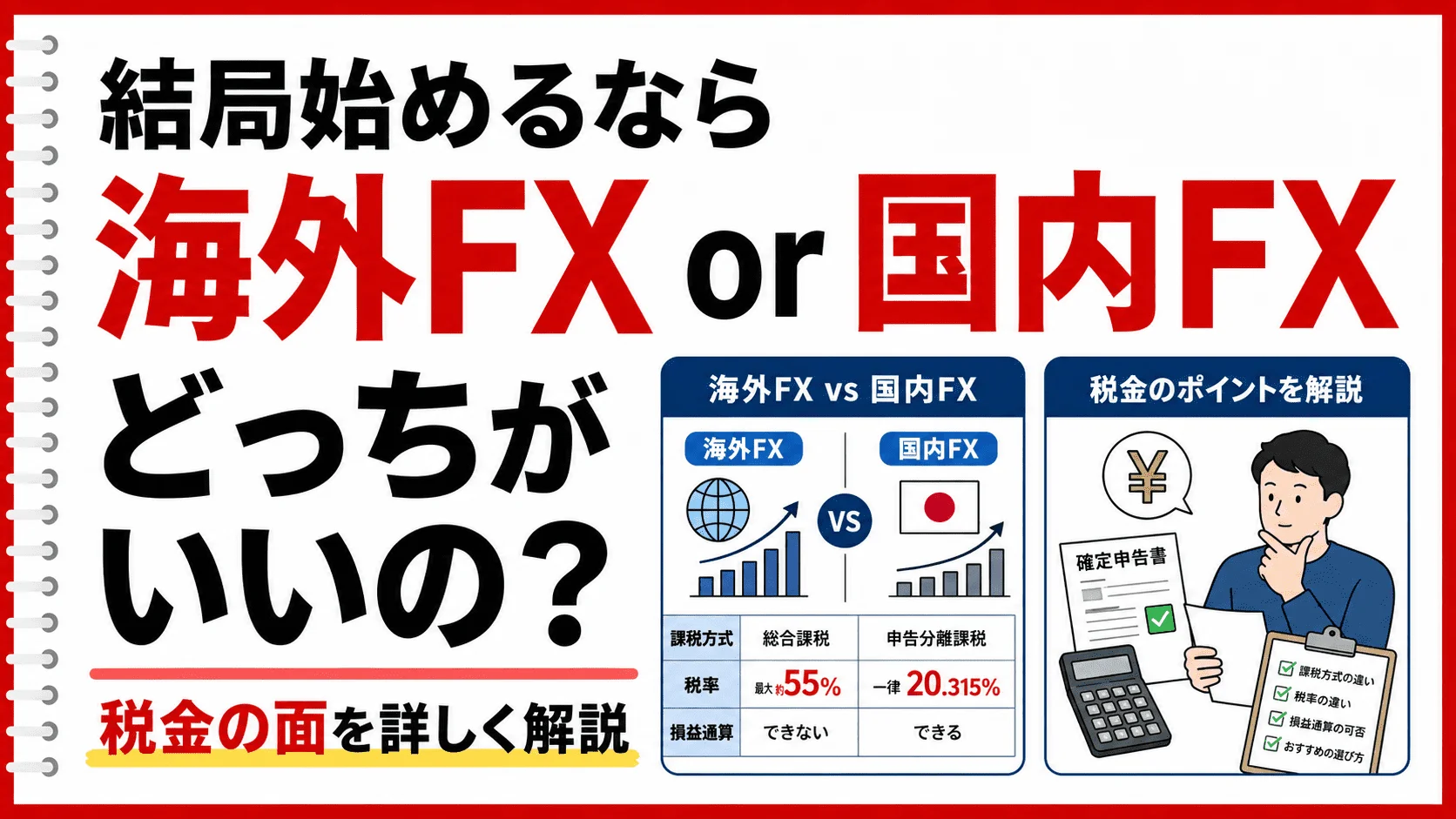
"Overseas FX takes a huge bite out of your winnings in tax, so what's the point of starting?" Quite a few people feel this way and stop just one step short of opening an account. Search online and you'll find headline after headline saying "progressive taxation of up to 55%." But that figure applies only to a very small high-income group. There is no need to brace yourself before you've even started.
Let me start with the conclusion. Tax on overseas FX is not "uniformly high." Depending on your income, it can be lower than domestic FX, about the same, or at a disadvantage. In this article we honestly show where that dividing line falls with a quick-reference table by taxable income bracket. We then go on to explain that what really determines your take-home is, in fact, not the tax rate.
Table of Contents
- So How Much Tax Do You Actually Pay on Overseas FX?
- "Taxes are high, so go with domestic FX" Is a Hasty Conclusion
- It's Not the Tax Rate That Really Decides Your Take-Home
- Three Elements of the Trading Environment That Determine Whether You Can Win
- FAQ
- Summary: Tax Comes After You Start. Begin First in an Environment Where It's Easy to Win
- Related articles
So How Much Tax Do You Actually Pay on Overseas FX?
First, the basics of tax classification. Profits from overseas FX fall under miscellaneous income under aggregate taxation. A progressive rate of 5% to 45% applies to your "taxable income," which combines these profits with other income such as salary. By contrast, profits from domestic FX, though also miscellaneous income, are subject to separate self-assessment taxation, which applies a flat 20.315% regardless of how much you earn (the total of income tax, special reconstruction income tax and resident tax).
Many people conclude that "overseas is progressive, so it's expensive," but in reality which side has the advantage flips depending on the taxable income bracket. The effective marginal tax rate on overseas FX is calculated as "income tax rate × 1.021 (including the special reconstruction income tax) + 10% resident tax." Set against the flat 20.315% for domestic FX, it looks like this.
Break-Even Quick-Reference Table by Taxable Income Bracket
* Taxable income is the amount after combining salary, FX profits and other income, and subtracting the various deductions.
Break-Even Quick-Reference Table by Taxable Income Bracket
| Taxable income bracket (after combining) | Overseas FX marginal tax rate (approx.) | Domestic FX (flat rate) | Which is better |
|---|---|---|---|
| Up to ¥1.95 million | approx. 15.1% | 20.315% | Overseas clearly cheaper (about 5 percentage points lower) |
| ¥1.95–3.3 million | approx. 20.2% | 20.315% | About the same ★ Most people just starting out fall in this bracket or below |
| ¥3.3–6.95 million | approx. 30.4% | 20.315% | Overseas FX at a disadvantage |
| ¥6.95–9 million | approx. 33.5% | 20.315% | Overseas FX at a disadvantage |
| ¥9–18 million | approx. 43.7% | 20.315% | Overseas FX at a considerable disadvantage |
| ¥18–40 million | approx. 50.8% | 20.315% | Overseas FX at a major disadvantage |
| Over ¥40 million | approx. 55.9% | 20.315% | Overseas FX at the biggest disadvantage |
What emerges is that the dividing line sits at around ¥3.3 million in taxable income. Below this point, overseas FX is on par with or cheaper than domestic FX, and once you go above it the positions reverse and overseas FX becomes disadvantageous. For people at the stage of "thinking about starting," I suspect that even after adding a small profit to their salary, many still sit below this bracket. In other words, in the early days there is almost no need to worry about losing out heavily on tax. The frequently seen "up to 55%" is merely the story of the bottom row of the table, the very small high-income group with taxable income over ¥40 million.
"Taxes are high, so go with domestic FX" Is a Hasty Conclusion
As the quick-reference table shows, the tax difference varies considerably by bracket. For low-to-middle income earners who have just started, overseas FX is cheaper than or the same as domestic FX. Deciding "it's progressive, so domestic" without looking at this is, after all, a hasty conclusion. To begin with, tax is that arises only once you make a profit. Judging by the tax rate alone before you have even started trading is, one might say, putting the cart before the horse.
That said, there are indeed points where overseas FX is clearly at a disadvantage on the tax side.
It's Not the Tax Rate That Really Decides Your Take-Home
So far we have kept talking about tax rates. But what greatly affects the money that ultimately stays in your hands, your take-home, is in fact not the tax rate. Take-home is determined by "profit × (1 − tax rate)." Let's split this formula into its two parts, profit and tax rate.
The following is merely an example to illustrate the mechanism.
- Person A: profit of ¥100,000 × tax rate of 15% → take-home ¥85,000
- Person B: profit of ¥500,000 × tax rate of 30% (a bracket on the disadvantaged side) → take-home ¥350,000
Person B's tax rate is double Person A's. Even so, thanks to a profit five times larger, take-home swells to roughly four times. In short, even if the tax rate is somewhat higher, the size of the profit has an overwhelmingly greater effect on take-home. If you don't make a profit, you can't even step into the arena where tax rates matter.
If so, what you should really pay attention to is not "a low tax rate" but "whether the environment lets you make a profit."
Three Elements of the Trading Environment That Determine Whether You Can Win
Whether you can make a profit depends on the trading environment. We explain whether overseas FX, and EdgeGraph FX in particular, is an environment where it is easy to win.
Trading environment elements and the tax context
| Trading environment element | Meaning in the tax context | Honest note |
|---|---|---|
| Leverage (EdgeGraph FX offers up to 1,000x) | Makes it possible to aim for profits large enough to be taxed even from a small starting capital. If profit is zero, the tax rate debate is meaningless | Domestic FX is up to 25x |
| Zero-cut, no additional margin calls | Institutionally prevents losses beyond your deposit, i.e. a negative take-home. Removes the risk of margin calls (debt) that can occur domestically | Even with zero-cut, the funds you deposited are lost. Losses do not become zero |
| Deposit bonuses and credits | Effectively increases your starting capital and speeds up the initial pace of profit. It can be the base that gets you up to the taxable line. Many overseas FX brokers offer deposit bonuses and the like. | Bonuses come with conditions. |
High leverage is a tool for aiming at "profits large enough to be taxed" even from a small amount. But big swings in profit mean, conversely, big swings in loss as well. Use leverage strategically, with risk in mind. Zero-cut is a mechanism under which, even if the market moves suddenly, you in principle won't be billed for more than you deposited, so you avoid the margin calls (additional deposits due to insufficient margin, effectively debt) that tend to occur with domestic FX. However, the funds you deposited can themselves be lost; zero-cut is not a "mechanism that stops you from losing" but strictly a risk management mechanism. Deposit bonuses speed up your starting capital. Please check the withdrawal conditions and so on before opening an account.
I think all of these are factors that come one step before "choosing by tax rate," factors that decide "whether this is an arena where you can make a profit."
FAQ
Q1. From what amount is overseas FX taxed? From what amount is a tax return required?
For salaried employees who receive pay from one place and have a year-end adjustment done, if the total of income other than salary and retirement pay (such as FX profits minus necessary expenses) is ¥200,000 or less per year, a final income tax return is in principle not required. Note, however, that a separate resident tax filing is often required. For people without salary income, the decision is made by thresholds such as the basic deduction. In any case, tax arises only once you make a profit, so there is no need to fear it before you start.
Q2. Is tax on overseas FX really high?
You can't lump it all together as high. In brackets with low taxable income (salary + FX profits) it is cheaper than or on par with domestic FX, and in higher brackets the positions reverse and it becomes disadvantageous. The rough dividing line is around ¥3.3 million in taxable income. At the stage of just starting out, many people should still be in a bracket where it is not yet a disadvantage.
Q3. Can a year's losses be offset against salary or the following year?
No, they can't. Because overseas FX falls under aggregate taxation, losses cannot be offset against other income such as salary, nor can they be carried forward to later years. This is where domestic FX (separate self-assessment taxation) has the edge: domestically, losses can be offset against profits from other FX, futures and the like, and carried forward for up to three years. Losses on overseas FX do not become something that reduces your tax. Understand that honestly.
Q4. If a loss is brought to zero by zero-cut, does it matter for the tax return?
Zero-cut is a mechanism by which you "do not take on a negative balance beyond your deposit"; it is not a system for lowering tax. Tax is imposed in years when you make a profit, and in a loss year losses cannot be offset, as in Q3. Zero-cut is a matter of risk management, not of tax.
Summary: Tax Comes After You Start. Begin First in an Environment Where It's Easy to Win
Tax on overseas FX is not "uniformly high"; whether it has the advantage or disadvantage against domestic FX flips depending on the taxable income bracket. For low-to-middle income earners who have just started, the tax burden often ends up about the same or lower. The weakness that you cannot offset losses or carry them forward is real, but that too only matters once profits or losses actually arise.
And what really moves your take-home is not the tax rate but the size of your profit. If so, wouldn't you agree it is worth more to try an environment where you can make a profit first, rather than stopping in your tracks worrying about tax rates? As an environment that makes it easy to take on the challenge from a small amount, EdgeGraph FX offers leverage of up to 1,000x, zero-cut with no margin calls, and deposit bonuses.
If you're anxious about putting in money right away, start by experiencing the feel of the platform and price movements with a risk-free demo trade. By the time you've got a sense of it and move on to opening an account, tax worries should have turned into "a deferred issue to think about once you've made a profit."
Experience the feel of MT5 and price movements for free with a risk-free demo trade
Learn how to start a demo account here!